
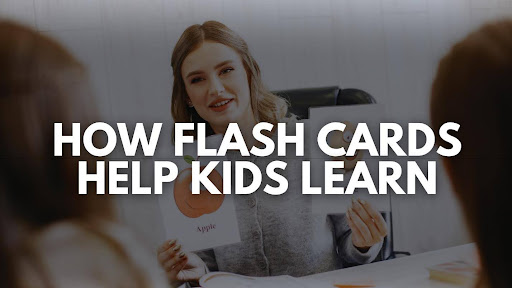
In the journey of childhood learning, simplicity often delivers the most powerful results. Among the many educational tools available today, flash cards remain one of the most effective and widely used methods for helping kids learn. Whether it’s recognizing letters, memorizing numbers, or building vocabulary, flash cards provide a structured yet engaging way to support early development.
Unlike passive learning methods, flash cards encourage active recall, repetition, and focus—three essential elements that significantly improve a child’s ability to absorb and retain information. In this article, we explore how flash cards help kids learn, why they are so effective, and how parents can maximize their benefits.
What Are Flash Cards and Why Do They Work?
Flash cards are simple learning tools that typically contain a question, word, or image on one side and the answer or explanation on the other. While they may seem basic, their effectiveness is backed by cognitive science.
Flash cards promote a learning technique known as active recall, where children are prompted to retrieve information from memory. This strengthens neural connections and improves long-term retention. They also support spaced repetition, which helps kids remember information over time rather than just short-term memorization.
Because flash cards are interactive, they naturally keep children engaged—making learning feel more like a game than a chore.
Strengthening Memory and Retention
One of the biggest advantages of flash cards is their ability to enhance memory. When kids repeatedly review flash cards, they reinforce what they’ve learned.
For example:
- Alphabet flash cards help children recognize letters quickly
- Number cards improve counting and numerical understanding
- Vocabulary cards expand language skills
The repetitive nature of flash cards builds confidence. As children begin to recognize answers more quickly, they feel a sense of achievement that motivates them to continue learning.
Improving Focus and Attention Span
Flash cards require kids to pay attention, even if only for short bursts. This makes them ideal for younger children who may struggle with long periods of concentration.
Short, focused sessions using flash cards can:
- Improve attention span over time
- Reduce distractions
- Encourage discipline in learning habits
Because sessions can be quick and flexible, parents can easily incorporate flash cards into daily routines without overwhelming their children.
Supporting Early Literacy and Language Skills
Flash cards are especially effective in developing literacy skills. They introduce children to letters, sounds, and words in a clear and visual way.
Using flash cards, kids can:
- Learn phonics and pronunciation
- Build vocabulary
- Improve reading readiness
Picture-based flash cards are particularly useful for younger learners, as they connect words with images, making it easier to understand and remember meanings.
Enhancing Math and Cognitive Skills
Flash cards are not limited to language learning—they are also excellent tools for teaching math concepts.
Children can use flash cards to practice:
- Basic arithmetic (addition, subtraction, multiplication)
- Number recognition
- Problem-solving skills
By repeatedly solving simple problems, kids build a strong foundation in math. Over time, they develop speed and accuracy, which are essential for more advanced learning.
Encouraging Independent Learning
Flash cards empower children to take control of their own learning. As they become familiar with the format, they can start using flash cards independently.
This promotes:
- Self-discipline
- Confidence
- Responsibility for learning
Kids enjoy the sense of accomplishment that comes from mastering a set of flash cards on their own.
Making Learning Fun and Interactive
One of the reasons flash cards are so effective is their flexibility. Parents can turn them into games to make learning more enjoyable.
Some fun ideas include:
- Timed challenges
- Matching games
- Quiz-style competitions
These activities keep children engaged while reinforcing key concepts. When learning feels fun, kids are more likely to stay motivated.
The Role of Parents in Flash Card Learning
Parents play a crucial role in maximizing the benefits of flash cards. Guided learning helps children stay on track and ensures they understand the material correctly.
Parents can:
- Customize flash cards based on their child’s needs
- Adjust difficulty levels gradually
- Provide encouragement and positive feedback
Short bonding moments during learning sessions can make a big difference. Even 10–15 minutes of focused interaction can significantly improve a child’s progress.
In addition to traditional methods, parents can also explore digital tools to complement learning. For example, after study sessions, families may unwind with light entertainment such as GameZone table game options, which offer interactive experiences that can help balance study and playtime. While not directly related to flash cards, this type of activity can serve as a reward system to keep children motivated.
Customizing Flash Cards for Better Results
Not all flash cards are created equal. Personalizing them can greatly enhance their effectiveness.
Tips for customization:
- Use colorful images for younger kids
- Include examples or sentences for older children
- Focus on one concept at a time
- Gradually increase difficulty
Parents can even create DIY flash cards at home, making the learning process more interactive and meaningful.
Digital vs. Physical Flash Cards
Today, flash cards come in both physical and digital formats. Each has its own advantages.
Physical flash cards:
- Provide hands-on learning
- Reduce screen time
- Improve tactile memory
Digital flash cards:
- Offer convenience and accessibility
- Include interactive features
- Allow for easy updates and customization
A balanced approach works best. Parents can use physical flash cards for daily practice and digital versions for variety.
Long-Term Benefits of Flash Card Learning
The skills developed through flash card learning extend beyond early education. These include:
- Strong memory retention
- Faster information processing
- Improved academic performance
- Better study habits
Flash cards lay the foundation for effective learning strategies that children can carry into higher education and beyond.
Conclusion
Flash cards may be simple, but their impact on a child’s learning journey is profound. By promoting active recall, improving focus, and making learning interactive, they provide a solid foundation for academic success.
With the support of parents and the right approach, flash cards can transform everyday learning into an engaging and rewarding experience. Whether used for letters, numbers, or vocabulary, they remain one of the most reliable tools for helping kids learn effectively.
In a world full of complex educational technologies, flash cards prove that sometimes the simplest methods are still the most powerful.