
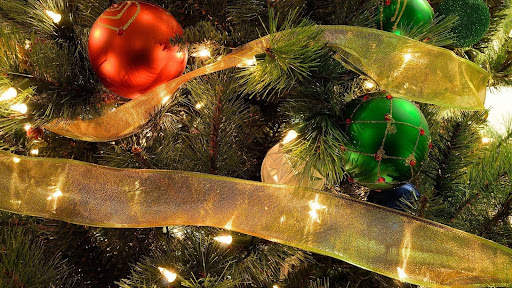
Shatterproof ornaments low, glass ones high. Photo: Wikimedia Commons (CC0)
It is the first weekend of December. The tree is finally standing in the living room, the string lights are glowing, and your two-year-old has already found the lowest branch, the shiniest ball and the cord running along the baseboard. All in about four minutes.
Most Christmas tree safety advice reads like a long list of rules, and parents tune out after rule six. A more useful way to look at it, and one that will help when you are tired: a natural fir in a home with small children has three risky moments. Setup day, the last stretch before Christmas when the needles start to dry out, and the week you take it down. Get those three right and the scary scenarios (a tipped trunk, a swallowed ornament hook, a fire) become a lot less likely.
Moment one: setup day decides most of the risk
A tree that wobbles on day one will wobble all holiday season, and a toddler pulling on a branch is a real test of the stand. Health Canada asks for two things here: a sturdy stand that holds the trunk securely, and a spot away from high-traffic areas, doorways, heating vents, radiators, stoves, fireplaces and lit candles. In a small condo or townhouse that rules out more corners than you would think, so choose the spot before it arrives, not while you are holding it. Leave at least a metre between the branches and any heat source if the room allows.
The trunk matters too. The American Academy of Pediatrics suggests you cut a few inches off the bottom before it goes into the stand so it can drink, and check it first: needles should be hard to pull off and should not snap when you bend them. Some families skip the wrestling match entirely. In Ottawa and Gatineau, for example, Treasy Ottawa delivers Canadian-grown balsam, Fraser and wild fir trees between mid-November and the days before Christmas, and the delivery person sets the tree up in its stand for you. If you are juggling a baby on one hip, having someone else level the trunk is worth a lot.

A corner keeps the tree out of the main traffic path. Photo: Wikimedia Commons (CC0)
Once it is up, decorate from the top down with kids in mind:
- Breakable, glass and heirloom ornaments go on the upper third, out of reach.
- Swap metal hooks for short loops of ribbon, a cheap holiday fix. Hooks fall to the floor and end up in mouths.
- Skip decorations that look like candy or cookies. The AAP flags them because toddlers try to eat them.
- Tinsel and garlands should be plastic or non-leaded metal, which Health Canada recommends for homes with young children.
A baby gate or a play yard panel around the base looks less festive than a tree skirt, but it works. A lot of parents only need it for one year, until the toddler stage passes. Safety gates also stop pets from reaching the stand.
Going with an artificial tree instead? Make sure the box says it is fire resistant or flame retardant, as the AAP advises. A flame retardant label only slows the spread of fire, so set an artificial tree up with the same distance from heaters and follow the same rules for the lights.
Are Christmas tree lights the real hazard?
Often, yes. A light string combines heat, electricity and a cord that a crawling child sees as a toy. Health Canada’s checklist is short and worth following to the letter. Buy lights that carry a Canadian certification mark such as CSA, cUL or cETL (these show the product was tested by a recognized testing laboratory). Check every strand before it goes on the branches and throw out any with frayed wires, loose connections or broken sockets. Use indoor sets indoors and outdoor-rated ones outside, and never plug so many strings into one outlet that the electrical circuit overheats.
Cords deserve their own attention. Do not run them across doorways or under rugs, where they get pinched or overheat. Turn every holiday decoration that plugs in off before bed and whenever you go out; a timer makes that automatic. The AAP adds a detail many parents miss: the wire coating and bulb sockets on some strands contain lead, so make sure the lower strands stay out of reach of little hands, especially when a child is teething, and wash your hands after handling them.
Battery operated decorations bring a different safety risk. Flameless candles, musical ornaments and light-up cards often run on button batteries, which can cause serious injuries if swallowed. Look for products with a screw-shut battery compartment and store spare batteries somewhere locked. Lit candles near the branches are a no for every family, kids or not. The NFPA notes that December is the peak month for home candle fires, so battery candles are the safe swap, as long as the battery door is screwed shut.
Moment two: the dry stretch before Christmas
This is the part people forget every year. A fresh-cut tree in a heated Canadian home loses moisture steadily, and a parched evergreen burns fast. The NFPA has repeated it for years: a small fire that spreads to a Christmas tree can grow large very quickly, which is why Christmas tree fires are so dangerous. Your best fire prevention tool is boring. Water the tree every day, as Health Canada recommends, and top up the stand so the base of the trunk is always submerged. Checking the water level morning and night is a safe habit in the first week.
A quick check every few days helps. Run your hand along a branch. If needles rain down or snap instead of bending, it is drying and the light display should stay off more often. Vacuum fallen needles daily too. They are not poisonous, but they can irritate a small mouth and throat if a curious toddler decides to taste them.
Gifts are the other late-December trap. Wrapping paper, bags and ribbons piled under the branches are a choking and suffocation hazard for small children, and paper near a hot bulb is fuel. Many parents keep presents out of sight until Christmas morning and clear the wrapping right after opening.
What if the tree does catch fire?
Get everyone out, close the door behind you if you can and call 911 from outside. Christmas tree fires spread fast through parched branches, so do not stop to grab gifts. Do not try to fight it with a pot from the kitchen. Every family needs a home fire escape plan that small children have practised, with two ways out of each room, plus working smoke alarms on each floor. December is a good month to test both and to make sure everyone, including the kids, knows the escape route and the meeting spot outside. Most Canadian fire departments repeat the same escape and fire prevention advice every winter.
Moment three: takedown without the mess
Health Canada’s rule is simple: remove the tree as soon as the holidays end, or as soon as the needles start to drop, because a dried-out tree is a fire hazard. The longer it stays up into January, the higher the risk.
Disposal depends on where you live, and most municipalities run a local tree recycling program, so check your city’s holiday collection page. In Ottawa, the City collects trees with the green bin. Remove every decoration, light and hook, then set it at the curb by 7 a.m. on your collection day. Trees wrapped in plastic bags, frozen into snowbanks or still carrying decorations are left behind. Collected trees are composted or mulched. You can also drop yours at the National Capital Commission site on Colonel By Drive, just west of the Bronson Avenue bridge, where donated trees are used along the Rideau Canal Skateway.
A short Christmas tree safety routine for busy parents
If you only remember a few holiday safety tips, make it these. Choose the spot before the tree arrives. Use a heavy stand and certified lights. Hang anything breakable up high. Water it daily, switch the lights off at night and keep the electrical cords tucked away. Take it down early in January and use your local collection day. That routine takes maybe five minutes a day, and it lets you enjoy the smell of a fresh fir with a toddler at home instead of hovering over it all month. None of it needs special gear, and the season stays safe and calm.