
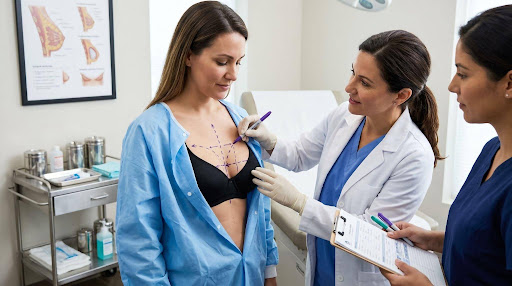
When researching cosmetic surgery, patients often compare surgeons by their experience, patient reviews, and before-and-after photographs. However, impressive results and a professional website do not necessarily explain a surgeon’s qualifications or specialist training. Understanding what certification means can help you evaluate a surgeon more carefully before making a decision about your health.
When considering breast augmentation surgeons, credentials can be a crucial step for any patient to undertake. There are differences between the certification of specialists and medical licenses in Canada, which may be useful when asking questions during consultations. Having the right questions on what should be checked, what is proven by certification, and other safety factors can make your consultation easier.
What Does Board Certification Mean in Canada?
Canada employs a medical qualification framework that is distinct from that utilized in the US. The term “board certification” is frequently used in the US. In Canada, specialist doctors are certified by the Royal College of Physicians and Surgeons of Canada after they meet the college’s residency and examination requirements.
The licensing system employed in Canada serves an entirely different purpose, with the license confirming the authority to practice, while the specialty certification shows compliance with the specialty standards. You can check the Royal College’s directory and your provincial regulator’s public register to verify a surgeon’s qualifications.
When researching breast augmentation surgeons, look for recognized plastic surgery credentials rather than relying on general descriptions such as “cosmetic specialist.” Ask the surgeon to clarify their training and certification if anything is unclear.
How Can Certification Contribute to Patient Safety?
Certification through special training and assessment ensures that there is a base level of medical and surgical knowledge and competence. All these qualities are important when deciding if a particular procedure is needed, when discussing possible risks, and when taking into consideration a patient’s anatomy and medical condition during procedure planning.
However, certification alone cannot guarantee a complication-free outcome. Patient safety also depends on current surgical experience, careful patient selection, clear communication, appropriate facilities, and postoperative monitoring.
As an example, a patient may be primarily interested in getting to a certain breast size but may not be paying attention to all the limitations of the implants and recovery. An experienced surgeon must clarify to the patient the possibilities and risks involved in the procedure, thereby allowing the patient to give informed consent.
What Does Canadian Research Reveal About Surgical Safety?
A study published in Plastic and Reconstructive Surgery – Global Open, titled “Medico-legal Closed Case Trends in Canadian Plastic Surgery: A Retrospective Descriptive Study,” examined 414 closed medico-legal cases involving Canadian plastic surgeons between 2013 and 2017. Of these, 253 involved cosmetic procedures. Within those cosmetic cases, 36.4% included allegations of deficient clinical assessment, 34.7% involved inadequate informed consent, and 12.6% involved inadequate monitoring or follow-up.
These figures describe allegations within selected medico-legal cases, not the proportion of all cosmetic surgeries that experience problems. Nevertheless, the findings highlight why careful assessment, clear explanations, and appropriate follow-up are important parts of surgical care.
What Else Should You Check Before Choosing a Surgeon?
Look for Procedure-Specific Experience
Certification can be helpful to start off, but it’s important that your surgeon has experience in performing your chosen procedure. Inquire about how often the surgeon performs breast augmentation surgery and if they have had any experience in dealing with issues like yours.
When choosing breast augmentation surgeons, it’s important that the surgeon talks about the implant sizes, locations, and types relative to your body.
Evaluate Communication and Follow-Up
Your consultation should give you enough information to make an informed decision. The surgeon should discuss potential benefits, limitations, complications, alternatives, and recovery expectations without pressuring you to proceed.
Also ask who will oversee your recovery, how postoperative concerns are handled, and what support is available if complications arise.
Check the Surgical Facility
Find out where your procedure will take place and what arrangements are in place for anesthesia, monitoring, and emergency support. Ask about the facility’s applicable licensing or accreditation and how the surgical team manages unexpected complications.
Questions to Ask During Your Consultation
Preparing questions can help you compare providers and identify areas that need clarification. When meeting breast augmentation surgeons, consider asking:
- What specialist qualifications and certifications do you hold?
- Where can I verify your licence and credentials?
- How frequently do you perform breast augmentation?
- What risks and alternatives apply to my situation?
- Where will the procedure take place?
- What follow-up care will I receive?
- How would you manage a complication if one occurred?
Use the answers to assess how clearly the surgeon communicates and whether you understand the proposed treatment plan.
| Factor | What to Verify |
| Credentials | Specialist certification and active provincial licence |
| Experience | Relevant breast augmentation experience |
| Informed consent | Clear explanation of risks, benefits, and alternatives |
| Facility | Appropriate surgical setting and safety arrangements |
| Follow-up | Recovery monitoring and access to postoperative care |
Make an Informed Decision About Your Surgical Care
Certification is an integral part of evaluating the surgeon, but it should not be the only thing that you need to consider when making a choice. One needs to check the certifications of the surgeon, find out whether the surgeon has any experience of performing a particular procedure, and evaluate how much he or she explains the possible risks and treatment options.
Canadian Surgery offers an individual approach to treatment and surgery in terms of planning, because its team includes several specialists dealing with particular aspects of aesthetics. Moreover, Canadian Surgery offers its patients the surgical suite in Toronto and even surgery by the same surgeon. Having all this information at hand will help you make an informed decision and feel more confident about your surgery.