
What Families Should Know
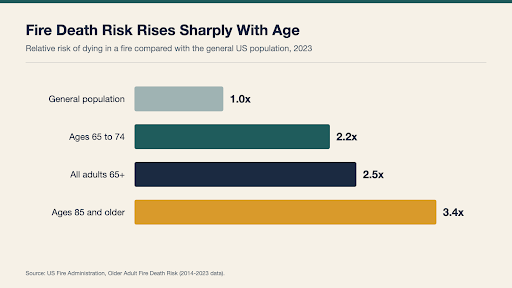
- Older adults face a much higher risk of dying in a fire, and US Fire Administration data puts the risk for people 85 and older at 3.4 times that of the general population.
- Elevators are usually out of service during a fire, so a resident who can’t walk stairs depends entirely on the community’s evacuation plan and the staff who carry it out.
- Nursing homes that take Medicare or Medicaid must plan for safe evacuation and test that plan at least twice a year, while assisted living rules vary by state.
- A tour is the right moment to ask how residents on upper floors get down, who helps them, and what equipment the staff actually use.
When you tour a senior living community, the questions usually center on care and cost, but one of the most important ones is how your parent would get out if the building had to be evacuated. Elevators are generally unavailable during a fire, which means any resident who can’t manage stairs relies on trained staff, a written plan and the right equipment to reach safety.
That equipment is worth asking about by name, because a dependable safety plan relies on specialized track-based emergency stair chairs mounted near the exits on every upper floor. These chairs are designed to assist mobility-impaired individuals down a staircase without anyone lifting them. Evacuscape, a Canadian-owned manufacturer that supplies long-term care and healthcare facilities across North America, builds its chairs so that one trained operator can guide a resident weighing up to 180 kg (400 lbs) down several flights smoothly. That matters on a night shift, because even a slightly built care aide can move a much heavier resident without risking a strain injury or a fall on the stairs. If a community can show you where its chairs are stored and tell you when staff last practiced with them, that’s a good sign the plan exists beyond paper.
Why Stairs Become the Problem in an Emergency
The risk isn’t evenly shared across age groups. The US Fire Administration’s analysis of older adult fire deaths found that in 2023, adults 65 and older were 2.5 times more likely to die in a fire than the general population. For people 85 and older, the risk was 3.4 times higher. Slower movement, hearing and vision changes, and medications that affect alertness all play a part.
In a multi-story building, the stairwell is where those risks come together. Fire codes and building practice generally take passenger elevators out of normal use once an alarm sounds, so a resident who uses a walker or wheelchair can’t simply ride down. They need someone to bring them down the stairs or to a protected waiting area until help arrives, and how quickly that happens depends on preparation that families rarely see.
Understanding Compliance: Are Evacuation Chairs Legally Required?
Federal rules set the floor, and they focus on planning more than equipment. Nursing homes that participate in Medicare or Medicaid must keep a written emergency plan and test it regularly, as the next section explains, but the rule doesn’t name a specific device for moving residents down the stairs.
Some states have gone further and written the equipment into law. California’s AB 3098, signed in 2018, requires every residential care facility for the elderly in the state to keep an evacuation chair at each stairwell, with a deadline of July 1, 2019. The same law requires a drill at least quarterly for each shift, a much tighter schedule than the twice-yearly exercises required of nursing homes.
In Canada, Section 125 of the Canada Labour Code requires federally regulated employers to ensure that employees have safe entry to, exit from and occupancy of the workplace, and to meet prescribed fire safety and emergency standards. Long-term care homes themselves fall under provincial rules, so families on both sides of the border should ask the same questions about equipment and drills, whatever their state or province requires.
What Nursing Homes Are Already Required to Plan For
Long-term care facilities that participate in Medicare or Medicaid have specific federal requirements. Under the federal emergency preparedness rule for long-term care facilities, a facility’s plan must cover safe evacuation, including the care and treatment needs of residents, staff responsibilities and transportation. The facility must also run exercises to test the plan at least twice a year.
Having a plan on file doesn’t guarantee it’s a good one. The HHS Office of Inspector General visited 24 nursing homes for its report on gaps in nursing home emergency preparedness. It found that emergency plans included only about half of the tasks on the CMS checklist, and that facilities faced problems such as unreliable transportation contracts.
Questions to Ask on Your Next Tour
The answers to these questions tell you more than a brochure can, and a well-run community should be comfortable answering all of them.
How Do Residents on Upper Floors Get Down?
Ask what happens, step by step, for a resident who can’t use the stairs on their own. A strong answer names the protected waiting area, the staff role responsible for each floor, and the equipment used for the descent. A vague answer about the fire department coming to help suggests the plan stops at the stairwell door.
What Equipment Do Staff Use, and Where Is It Kept?
Judging a community’s readiness means checking the exact type of equipment it keeps on site. The National Fire Protection Association’s evacuation planning guide for people with disabilities notes that carry-type devices need two or more operators to lift and carry a resident, which is a serious weakness on a night or weekend shift when fewer staff are on duty. Track-type chairs solve that staffing problem, because continuous V-belt friction tracks grip the edges of the stairs and carry the resident’s weight while one operator guides the angle and speed of the descent. Ask to see where the chairs are kept, and make sure they’re stored in the open at refuge points or stairwell landings, free of locks and anything that would slow staff down.
When Did Staff Last Practice?
A drill that only tests the alarm tells you little about stair evacuation. Ask whether staff on every shift, including nights and weekends, have practiced moving a person down the stairs, because a fire at 3 a.m. will be handled by whoever is on duty at 3 a.m.
How Will the Community Reach Our Family?
Find out who calls families during and after an evacuation, and where residents would be taken if they couldn’t return the same day. Ask to see the relevant section of the emergency plan, since nursing homes are required to have one.
Why Elevators Are Rarely Part of the Plan
Passenger elevators are generally recalled to a designated floor when a fire alarm activates, and after that only firefighters can operate them with a key. Some newer buildings have elevators designed for occupant evacuation, but most senior communities don’t, so residents who use wheelchairs or walkers are moved down the stairs or wait in a protected area for help. Evacuation chairs work without electricity, which keeps them usable when elevators and other powered equipment aren’t. Ask whether any elevator is part of the community’s plan, and if the answer is no, ask how many chairs are kept on each upper floor.
Choosing a Room With Evacuation in Mind
A ground-floor room takes the stairs out of the equation, which makes evacuation simpler and faster for someone who uses a wheelchair or walker. When only upper-floor rooms are available, look for a unit close to a stairwell that has an evacuation chair stored nearby and a protected waiting area on the same floor. If your parent’s mobility is likely to decline, ask now whether a move to the ground floor would be possible later.
How Assisted Living Rules Differ From Nursing Home Rules
The federal emergency preparedness requirements apply to facilities that take Medicare or Medicaid, which covers nursing homes but usually not assisted living. Assisted living communities are licensed by states, and their evacuation rules range from detailed equipment and drill mandates, like California’s, to general planning requirements. Because there’s no single national standard, your own questions during a tour carry more weight in assisted living than they do in a nursing home.
What to Do If the Answers Fall Short
Treat a weak answer on evacuation the same way you’d treat a weak answer on staffing or medication management, as a real factor in your decision. Ask the community to put its plan in writing, compare its answers with those of other communities you’re considering, or contact your state’s long-term care ombudsman program. Inspection reports, which are public for nursing homes, can also show whether a facility has been cited for emergency preparedness problems.
Make Evacuation Part of Your Next Tour
Choosing a senior community is about how your parent will live day to day, and a sound evacuation plan is part of that. Before you sign, ask to see the equipment, the drill records and the written plan, and listen for specific answers about who helps residents down the stairs on every shift. A community that welcomes those questions has usually already done the work to answer them.

Make Evacuation Part of Your Next Tour
Choosing a senior community is about how your parent will live day to day, and a sound evacuation plan is part of that. Before you sign, ask to see the equipment, the drill records and the written plan, and listen for specific answers about who helps residents down the stairs on every shift. A community that welcomes those questions has usually already done the work to answer them.